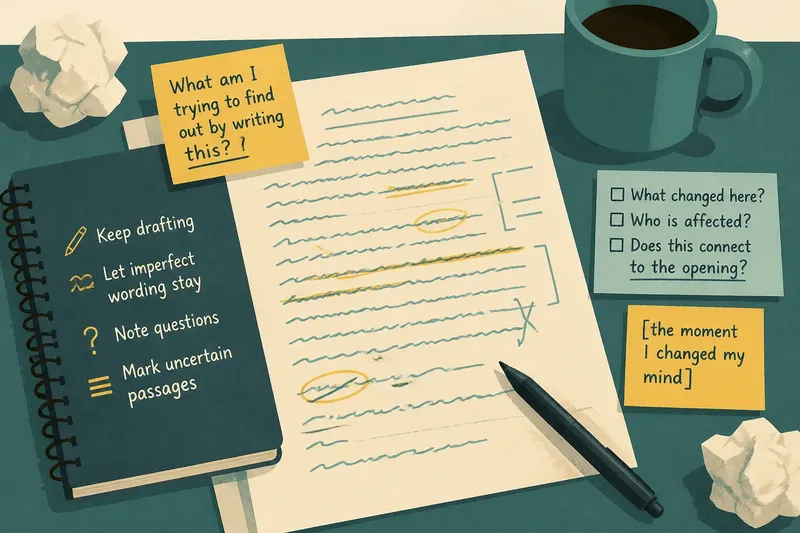
A Personal Year-End Review Without the Scorecard
A personal year-end review without a scorecard helps you choose what to continue, release and explore, without reducing a complicated year to a verdict.

A personal year-end review without a scorecard can help you choose what belongs in the next stretch of life, without grading the months that came before. Instead of asking whether the year was good or bad, look for three kinds of signals: what you want to continue, what you are ready to release, and what you would like to explore.
This is a decision guide, not a demand to feel grateful, find a lesson in every hard thing, or turn your life into a project. The right approach depends on what kind of year you have had and how much room you have for reflection. Choose the path that feels usable, then keep the exercise small enough to finish.
Choose a review that fits the year you actually had
Before reaching for a notebook, name the broad shape of the year. You might have been carrying a new responsibility, recovering from a difficult period, living through a stretch of uncertainty, or simply moving through an ordinary year with no dramatic turning point. These situations call for different kinds of attention.
Think of the review as sorting a drawer, not judging everything you own. Some things have been useful and can stay; some no longer fit; others are worth trying in a different form. You do not have to explain or defend each choice.
- If the year was demanding, begin with what helped you get through it. Keep the review gentle and brief; do not turn survival into another standard you must meet.
- If the year brought a major change, focus on what feels settled and what remains in motion. A decision made during upheaval may deserve a second look, but it does not need an immediate verdict.
- If the year felt repetitive or hard to read, look for small preferences and recurring friction. Ordinary patterns can be more useful than a dramatic story about personal transformation.
- If the year held several bright spots, ask what made those moments possible. The practical conditions around a good experience may be easier to carry forward than the experience itself.
You can also choose the amount of structure. A page of notes suits someone who wants to see their thoughts together. A short conversation with a trusted person may suit someone who thinks more clearly aloud. If reflection tends to become rumination, set a modest time boundary and stop when it rings.
Start with what deserves to continue
“Continue” does not mean preserve every routine or repeat every success. It means noticing what has felt worthwhile, supportive, or true to your values, then deciding what form it could take next. That might be a regular walk with a neighbour, an evening without work messages, or making time for a craft that brings your attention back to the present.
Look beyond the headline moments. Ask what you kept returning to, what helped you feel more like yourself, or what made an ordinary day easier to inhabit. Consider the people, places, habits and boundaries involved. A good experience may depend on a specific arrangement rather than a vague quality such as “being more productive”.
Say you have enjoyed cooking with your sibling but found the late finish difficult. You could decide to continue the shared meal while suggesting an earlier start. The choice preserves the connection and changes the part that made it hard to repeat.
For each thing you might continue, write one plain sentence about its next form. “Keep seeing Maya” is a feeling; “ask Maya to meet for a weekend walk when our schedules allow” gives the feeling somewhere to go. You are not making a binding promise. You are identifying a direction worth considering.
Release what no longer earns its place
Release can sound like a dramatic break, but it often means loosening an expectation. Perhaps you kept a routine because you once needed it, agreed to a role that no longer suits your capacity, or carried a private rule about how quickly you should make progress. A review can help you notice these burdens without accusing your past self of getting it wrong.
Separate what you control from what you do not. You may be able to stop volunteering for an extra task, but you may not be able to change a family member’s behaviour or resolve a difficult situation on your preferred timetable. In the latter case, releasing could mean dropping the expectation that you must solve it alone, rather than abandoning a person or responsibility.
Try these prompts:
- What am I continuing mainly because I fear disappointing someone?
- Which commitment has become more costly than I expected?
- What standard am I using that I would not impose on a friend?
- Is there something I can pause, reduce, renegotiate or ask for help with?
Then choose a proportionate response. A routine might be paused for a while. A commitment might be discussed with the person who shares it. An expectation may simply be rewritten in kinder, more realistic terms. For responsibilities with serious consequences, make decisions carefully and seek suitable support where needed; reflection is not a substitute for practical advice.
It is also fine to leave an item unresolved. Write “not deciding yet” and name what information or time would help. That is a real choice, not a failure to complete the exercise.
Explore something without turning it into a target
Exploration is for what draws your attention, even if you do not know where it will lead. You might want to visit a local community garden, try a beginner pottery session, read about a subject that has surfaced in conversation, or spend an afternoon in a neighbourhood you rarely visit. The point is to meet the possibility, not to prove that you can stick with it.
Keep the first invitation light. Ask what would let you try the idea without reorganising your life around it. A library book, a drop-in event, or a conversation with someone who knows the activity may be enough to find out whether your curiosity grows.
Notice the difference between interest and obligation. “I want to understand how community choirs work” is an invitation. “I should become a confident singer” adds a test that may have little to do with the original curiosity. Let the question remain open until you have had a chance to encounter the thing itself.
Which reflection style fits your situation?
What if the year was painful or exhausting?
Use a recovery-focused review. Note what provided steadiness, what needs less from you now, and what support you may want to ask for. You can leave “explore” blank; there is no need to create excitement on command.
What if I cannot remember much of the year?
Use ordinary anchors rather than forcing a complete timeline. Look at your calendar, saved messages, or recurring appointments for prompts, then write down only what you recognise as meaningful. The aim is a helpful view, not a perfect record.
What if I feel proud of the year?
Let pride belong in the review without converting it into a ranking. Ask what helped you do work you value and which parts of that approach you want to carry forward, while making room for rest and changing circumstances.
What if I do not want to make plans yet?
Make the review a set of observations, not a plan. You might keep a short note of what to continue, release, or explore and return to it when a decision naturally comes up.
Turn the notes into choices you can live with
Once you have written a few thoughts under the three prompts, read them back and look for the smallest useful decision. You may want to make one conversation, remove one unnecessary obligation, or leave space to try something new. You do not need a matching item in every category, and you do not need to act on every thought at once.
For each possible choice, ask whether it is yours to make, whether it fits your current capacity, and whether it needs another person’s input. If it depends on someone else, phrase it as an invitation or a conversation rather than a private plan for what they will do. If it depends on uncertain circumstances, keep the choice flexible.
Be specific enough to recognise the decision later. “Explore more” is difficult to act on; “ask the library about its local history group” is a clear first enquiry. “Release stress” is too broad; “decline the optional committee role this season” identifies a choice, if that is genuinely available to you.
When the notes feel complete, finish with a sentence that does not rate the year. For example: “I want to keep making room for people who help me feel at ease, let go of the idea that every evening must be productive, and stay curious about the ceramics class.” Your version can be quieter, more uncertain, or focused on rest.
Keep the review useful after the page is closed
A personal year-end review works best when its notes remain available without becoming another demand. Put the page somewhere you can find it, or keep a brief version in your phone. Return to it when a relevant choice appears, not because a calendar says you must reassess your whole life.
As the next stretch unfolds, your answer may change. A practice you wanted to continue might stop fitting; an idea you set aside may become interesting later. That does not make the reflection unreliable. It means you are responding to the life in front of you.
The most useful result may be one modest decision rather than a new direction. Keep what still nourishes you, release what you can, and let curiosity remain a question until you are ready to meet it.