The First-Draft Trap: Why Polishing Can Hide the Point
The first-draft trap can blur an emerging idea. Learn how to pause sentence-level edits, develop your point and return to revision with clearer choices.
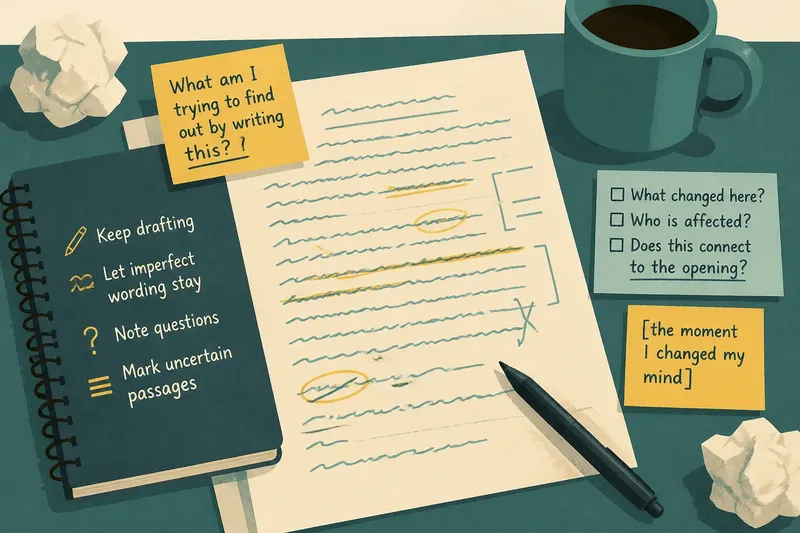
The first-draft trap begins when you polish sentences before you know what the piece is trying to say. A smoother opening can feel like progress, yet it may make a half-formed idea harder to see.
Editing matters; timing is the issue. When you make ideas and revise sentences at the same time, each line has to carry a thought and pass judgement on itself. Giving those tasks separate turns lets the central point emerge before you shape it for readers.
Why premature editing can hide the point
Polishing too early makes local improvements before the larger direction is settled. You replace a vague word, tidy a transition or recast a sentence, but those choices can commit the draft to an idea you have not examined.
Suppose a paragraph begins with an appealing detail that does not yet connect to the rest. If you keep refining it, the finished-sounding wording may persuade you to keep the paragraph for the wrong reason. The work starts serving the sentence rather than the thought that prompted you to write.
Editing can also interrupt the chain of association. One rough sentence might lead to a more useful one, then to a question that gives the passage direction. If you stop after every line to judge its quality, you may never reach that thought.
An unfinished draft is like a table covered with jigsaw pieces. It is too early to varnish each piece; first, you need enough of the picture to see which pieces belong together. Early writing is material to work with, not a verdict on your ability.
Signs your idea is still developing
An idea is still developing when you can sense its subject but cannot explain how its parts relate. You might have an image, a complaint, a question and a possible conclusion, without knowing which one carries the weight.
Try stating the point aloud. If you keep adding qualifications, changing the subject or reaching for a more impressive phrase, the underlying claim may still be unsettled. That does not make the idea weak; it means the draft may need more room before it needs polish.
Look for these signs, then decide whether to keep drafting or move on to revision:
- If you revise the opening repeatedly while the body changes direction, note the competing subjects and draft forward until one becomes clearer; if the body now supports a single claim, revise the opening to match it.
- If you delete an awkward sentence before asking what it says, leave it in place and add a note about its possible meaning; if it contains no useful thought, remove it on a later pass.
- If you choose synonyms instead of adding the detail that prompted you to write, insert a plain placeholder such as “[the moment I changed my mind]”; if the detail is already clear, return to the sentence and refine its wording.
- If you smooth transitions between paragraphs whose relationship is uncertain, write a short note naming the link you expect; if you cannot name one, test a different order or remove the weaker paragraph.
- If an elegant sentence feels satisfying but you cannot say what it contributes, write its job in the margin; if it has no clear job, cut it or set it aside.
- If you feel unable to continue because a phrase is missing, write the nearest honest version and keep going; if the missing phrase changes the meaning, mark the gap and return when the idea is clearer.
Any one sign can be ordinary. Together, they suggest that sentence-level editing has moved ahead of idea-making. Ask, “What am I trying to find out by writing this?” rather than “Is this good?”
How can you draft without polishing every sentence?
Give yourself a defined stretch in which the task is to develop the thought. You might write freely without rereading, draft a few paragraphs, or leave a marker such as “[example]” where a detail is missing. Pick a boundary that helps you continue rather than a rule you must obey perfectly.
Let imperfect wording stay. If you cannot find the exact phrase, write the nearest honest version and move on. A plain note such as “I’m trying to say that…” can preserve the idea without pretending it is ready for readers.
Keep unresolved questions beside the draft instead of stopping to answer each one. Write down questions such as “What changed here?”, “Who is affected?” or “Does this connect to the opening?” When you revise the whole piece, you can decide which questions need answers.
Mark uncertain passages with a symbol or highlight. On a later pass, decide whether each passage needs an example, a clearer claim, a different position or removal.
How do you separate drafting from revision?
Separate the tasks by purpose, not by pretending they never overlap. Drafting asks what the piece might be saying; revision asks what it needs in order to say that clearly. Correct a typo if it distracts you, but avoid making every sentence a miniature editing project.
Say you are writing about why a weekly walk helps you think through a difficult choice. You begin with wet pavement, then realise the useful point is not the scenery but the way walking lets you consider one concern at a time. Instead of polishing the pavement paragraph, add a rough note about that shift and continue. On a later pass, decide whether the image belongs and shape the explanation around the point that emerged.
This is an invented situation, not a formula for every draft. Its useful distinction is between keeping early material available and deciding what belongs in the finished piece.
When you return to revise, read the whole piece without changing anything. Write one sentence describing its current point. If that sentence differs from what you intended, ask what the draft actually supports. Then work from larger decisions to smaller ones:
- If the main idea and the reader’s reason to care are unclear, rewrite the point in a plain sentence before editing individual lines; if both are clear, keep them as your guide.
- If a section does not support the point, move, combine or remove it; if it does support the point, keep it and check its place in the sequence.
- If the reasoning feels thin, add a concrete detail or explain the link between claims; if the reasoning already follows, leave the passage intact for now.
- If paragraph openings make the sequence hard to follow, revise their order or transitions; if the sequence is clear aloud, avoid adding unnecessary signposts.
- If a sentence is hard to understand, simplify its wording; if its meaning is clear, polish rhythm, punctuation and spelling only after the larger choices are settled.
- If a passage repeats an earlier point without adding anything, cut or combine it; if it adds a useful qualification, make that contribution explicit.
This order helps you avoid perfecting a passage that later needs to move or disappear. Each change answers a question about the piece instead of merely making the page look finished.
When is a sentence-level edit worth making?
A small edit is useful when it removes an obstacle without pulling you away from developing the idea. Correcting a misspelling, adding a missing word or replacing a confusing placeholder may let you continue. Rewriting a paragraph for elegance is more likely to belong on a later pass.
Ask, “Will this change help me keep going, or am I trying to prove that this draft is already good?” If it supports forward movement, make it. If it invites a chain of cosmetic choices, leave a note and return to the thought.
If a tidy page helps you concentrate, limit yourself to edits that block comprehension, then resume drafting. The aim is not to ban pleasure in language. It is to stop that pleasure from deciding the direction before you have discovered it.
What if rough writing makes you doubt yourself?
Rough writing is evidence that a draft is unfinished, not evidence that you have nothing to say. The distance between a thought and its clearest expression can feel uncomfortable, especially if you judge your work by how finished it looks. Let the page hold that uncertainty for now.
Write a private note about what you hope the draft will become. Keep it separate from the draft and make it candid: “I think this is about…” or “The part I do not understand yet is…”. It gives you a reference point without forcing the opening paragraph to carry the whole meaning.
If confidence is low, make the next task smaller. Add one concrete observation, answer one open question or write the sentence you are avoiding in plain language. You do not need to settle the whole argument before continuing; another useful thought may appear once an imperfect one is on the page.
Should you ever edit as you go?
Can I correct a typo while drafting?
Yes, if the typo distracts you or makes the sentence hard to understand. Correct it and continue without turning the moment into a broader rewrite.
What if I naturally revise each sentence as I write?
You do not need to forbid yourself from making small adjustments. Notice whether the edits help you express the thought or keep you circling the same lines while the central idea remains unclear.
How do I know when to stop polishing the opening?
If the body is still changing direction, leave the opening alone and write forward. Return to it once you can state what the draft supports.
Does a rough draft need to be complete before revision?
No. You can revise a section once its purpose is clear, even if the whole piece is unfinished. Keep track of unanswered questions so local edits do not lock in a direction the rest of the draft may not support.
The first-draft trap is not caring about good sentences; it is asking them to settle the point too soon. When you search for ways to escape it, let the thought arrive before requiring every line to perform. Then use revision to make the draft’s actual point easier to see.